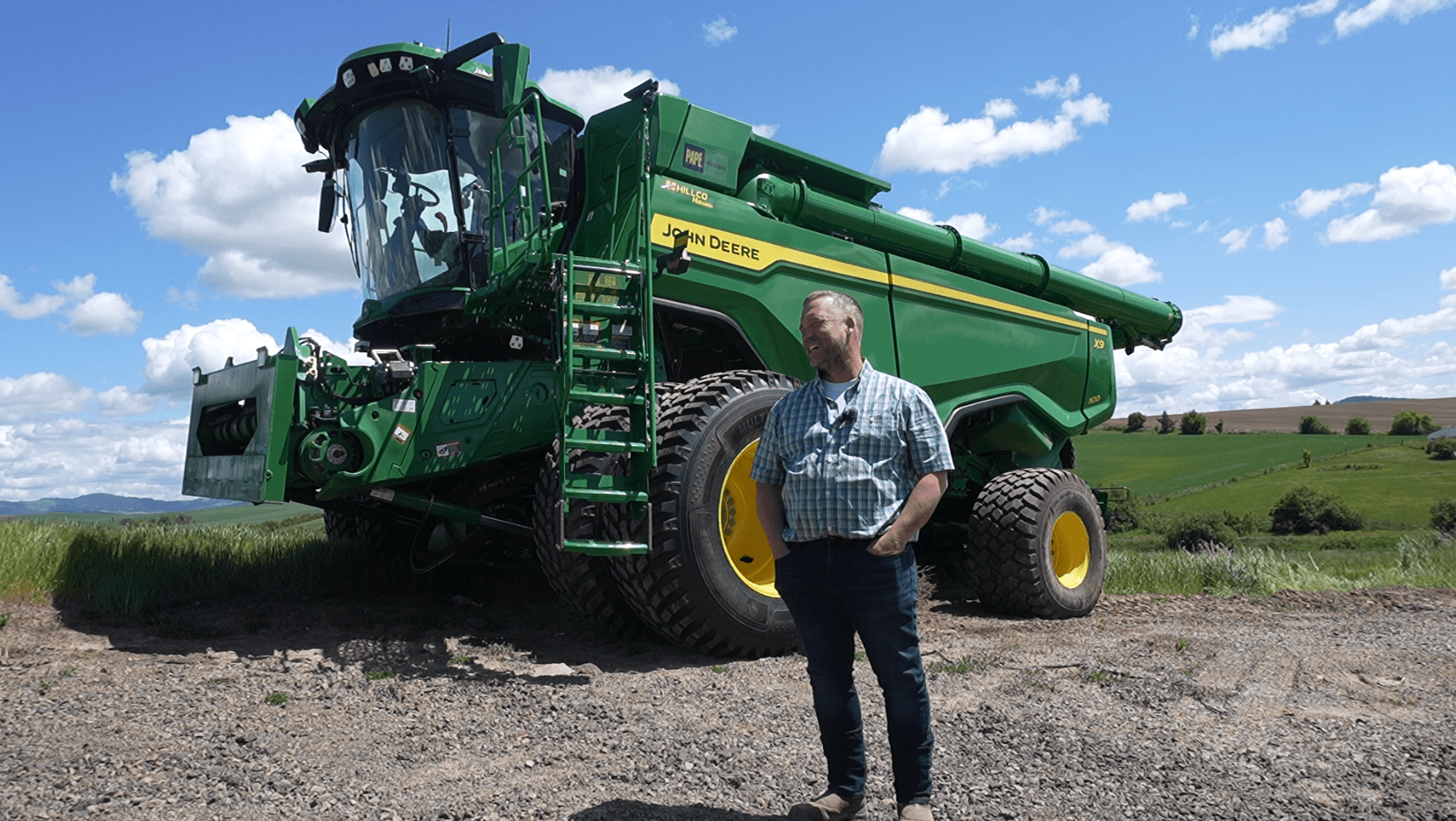
A conversation with Seth Millhorn of Millhorn Farms about hillside harvest efficiency, grain loss, uptime, and the move to a Hillco-equipped John Deere X9.
A conversation with Seth Millhorn of Millhorn Farms about hillside harvest efficiency, grain loss, uptime, and the move to a Hillco-equipped John Deere X9.
On steep ground, the shortest line across a field is not always the line a combine can take efficiently. Operators may contour around slopes, change travel direction, slow down, or watch grain loss closely enough that the terrain starts dictating the harvest plan. For Millhorn Farms, that is exactly why a combine leveling system is not treated as a comfort feature. It is part of how the operation protects grain and uses people, machines, and harvest hours.
Seth Millhorn is part of a fourth-generation family farm in the northeastern Palouse region. The family began clearing ground around 1907. Today, the operation raises a mix of grain and forage crops across roughly 30,000 continuously cropped acres, most of them dependent on what the season brings for rainfall. On the grain side, Millhorn says nearly everything requires a hillside combine.
Like many farms, Millhorn Farms faces a hard limit that cannot be solved by adding another line to a specification sheet: available people. Seth describes labor as agriculture’s “number one limiting factor.” That made production capacity central to the farm’s decision to move into a John Deere X9.
The farm had been waiting for Hillco to take on the engineering work required to pair a leveling system with the X-Series platform. Millhorn Farms ran the prototype during the 2025 harvest and then chose the X9 on a production basis. In Seth’s account, the prototype gave the operation the capacity it was looking for compared with the combines it had been running.
Hillco product context
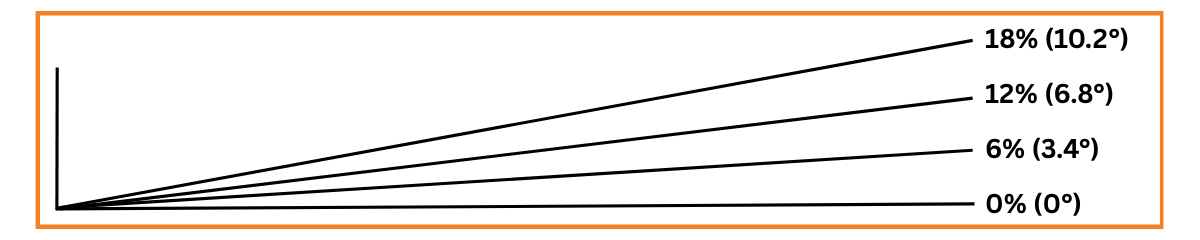
Hillco currently offers John Deere combine leveling systems for supported STS, S-Series, S7, and X-Series machines. Available configurations include 18% Sidehill and 27% Hillside models. Fitment varies by combine, header, tires, and configuration; work with an authorized dealer on the correct system.
A Level Combine Enables the Cleaning System To Do Its Job on Slopes
Why does leveling matter beyond the cab? When a combine operates across a slope, gravity can move crop material toward the downhill side of the cleaning system. Uneven loading can make it harder to use the full cleaning area effectively. A Hillco Leveling System is designed to sense chassis position and automatically pivot the combine to maintain level within the system’s compensation range.
Hillco’s variable-speed hydraulic leveling responds faster when the chassis is farther out of level, then slows as the machine approaches level. Hillco systems also incorporate automatic header height and lateral tilt control when properly equipped. The goal is straightforward: keep the combine working more like it does on level ground, even when the field is not level.
For the operator, the practical benefits can include reduced hillside grain loss, more usable hillside capacity, improved sample quality, and a more comfortable operating position. Actual results depend on crop, slope, yield, machine settings, ground speed, and field conditions. The right comparison is the one built from your own acres and harvest records.
Field Layout Becomes an Efficiency Decision Again
One of Seth’s points is less specific, and more of a concept. It is a change in how the farm can approach the field.
Without leveling, operators may lay out passes around where they expect grain loss or cleaning-system performance to become limiting. On the Palouse, that often means contouring, avoiding certain up-and-down routes, or making small horseshoe-shaped passes that are difficult to manage with multiple combines and fleet guidance.
With a properly configured automatic combine leveling system, Seth says his team instead plans routes for field efficiency. If the next pass involves going downhill, uphill, or across the side of the slope, it does not matter. The terrain does not dictate their pattern. As Millhorn says, that matters when four combines and the supporting fleet need predictable lines, fewer awkward turns, and a clean path through the field.
“You no longer have to lay out your fields based on monitoring grain loss. You get to lay out your fields for efficiency.”
–Seth Millhorn, Millhorn Farms
Grain Loss and Throughput Belong in the Same Conversation
A farm should not have to choose between slowing an expensive combine and accepting grain out the back. That tradeoff becomes especially difficult when margins are tight and weather compresses the harvest window.
Millhorn’s view: if grain loss on hillsides is a recurring discussion, the operation should evaluate whether leveling belongs in the solution. On his farm, he estimates only a small portion of the ground could be harvested without a leveler, while much of the remaining acreage either benefits from one or requires one. He also believes the grain retained on the farm’s flattest ground can justify the investment quickly. That is Millhorn Farms’ experience, not a universal payback promise, but it shows why operators should calculate the effect across the entire acre base rather than looking only at the steepest field.
Uptime Is Part of the Value
Efficiency gains only mean much if an added system becomes a harvest bottleneck. Millhorn Farms switched to Hillco systems in 2006. Before the interview, Seth’s team reviewed their history with Hillco machines and identified three leveling-system related breakdowns across what he estimated at roughly 20,000 combined operating hours. He described those events as straightforward electrical or hydraulic-control issues, such as a solenoid or sensor, and said the farm had not experienced a hard-part failure.
That customer experience belongs to Millhorn’s operation with its own variables: machines, maintenance, conditions, and operators. Seth also points to the value of direct support. When his operation has had a question, he says Hillco and his local dealer have been available to help diagnose and resolve it.
Do the Math With Your Farm’s Numbers
A combine leveling system is a significant capital investment, and the most useful evaluation starts with your operation’s own numbers. Hillco developed its ROI Calculator using years of research to help owners and operators estimate potential grain savings and better understand how a leveling system may affect their operation.
When Seth does his calculations, he also considers what happens to the value of the equipment over time. In his experience, the combine is the faster-depreciating asset, while the leveling system tends to retain more of its value because it is not subject to the same kind of wear. He says that value can still be visible when a used combine equipped with a leveler is compared with a similar machine without one. That is Millhorn Farms’ market observation, not a guaranteed resale result, but it is a useful factor to discuss with your dealer when comparing total ownership cost.
Hillco’s online ROI Calculator provides a practical place to organize those numbers. The calculator lets you enter your crop acres, slope distribution, harvest speed, estimated machine-harvested-yield reduction, fuel use, separator-hour cost, financing assumptions, and leveling-system value. Its results are estimates, so the strongest inputs will come from your own loss checks, field maps, speed records, equipment values, and current dealer information.
Those questions respect the way generational farms make durable equipment decisions: with field records, operator experience, service access, and a clear view of cash flow. A leveler may be the right answer, or it may identify where more information is needed. Either way, the decision should be grounded in the cost of the current constraint.
For Millhorn Farms, Leveling Is Part of the Harvest System
Millhorn Farms did not choose a Hillco-equipped X9 because the ground became easier. The farm chose it because people are limited, capacity matters, and the hills are not going away. Keeping the combine level helps the team protect grain while choosing more efficient lines through the field and putting the machine’s capacity to work.
That is the larger lesson in Seth’s story. On rolling or steep ground, leveling is not an isolated attachment decision. It affects how the combine cleans, how the operator drives, how the fleet moves, and how the farm measures the value of each harvest hour.
To learn whether a Hillco Hillside or Sidehill Leveling System fits your combine and field conditions, talk with your authorized dealer or contact Hillco Technologies. Bring your combine model, header configuration, tire setup, slope distribution, and harvest records so the conversation can start with your operation’s facts.
Frequently Asked Questions
What does a combine leveling system do?
A combine leveling system senses chassis position on a slope and pivots the combine to maintain a more level operating position within its rated compensation range. Keeping the chassis level helps crop material stay more evenly distributed across the cleaning system. Every degree of slope costs you yield, speed, and separator hours.
How can a leveling system help reduce grain loss on hillsides?
When crop material shifts toward the downhill side, the cleaning system may not use its full area as effectively. Leveling the chassis can support more even loading and help the combine maintain cleaning performance, speed, and efficiency. For the full breakdown and to walk through the details of your operation call our sales office at 1-800-937-2461.
What is the difference between Hillco Sidehill and Hillside models?
Hillco Sidehill models offer 18% slope compensation and Hillside models as offer 27% slope compensation. The correct system depends on combine model, terrain, tires, headers, transport needs, and dealer-reviewed configuration.
Can a Hillco Leveling System be installed on a used combine?
Hillco systems are bolt-on designs and supported used John Deere combines can be equipped through an authorized dealer. Confirm current model-year and configuration compatibility before purchasing. Another option is to use the Hillco resource “Find Used Leveling Combines.” This will give you a list of dealership locations where combines equipped with Hillco Leveling Systems are commonly taken in on trade.
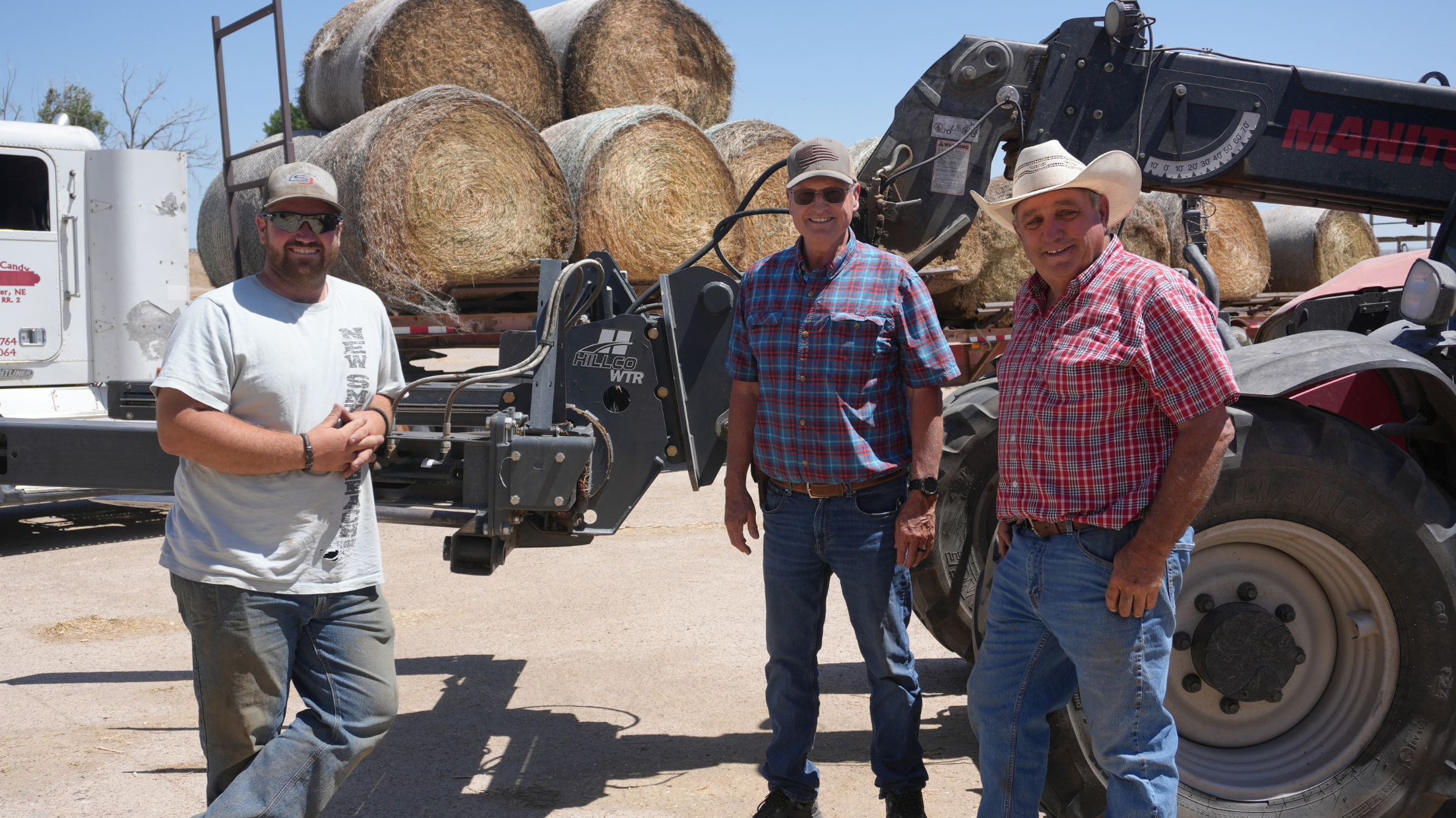
Cutting the net wrap or twine off one bale isn’t something a person thinks much about, but a few hundred bales—that’ll get your attention. At Oshkosh Heifer Development in western Nebraska, experienced hay-grinding professionals Marty…
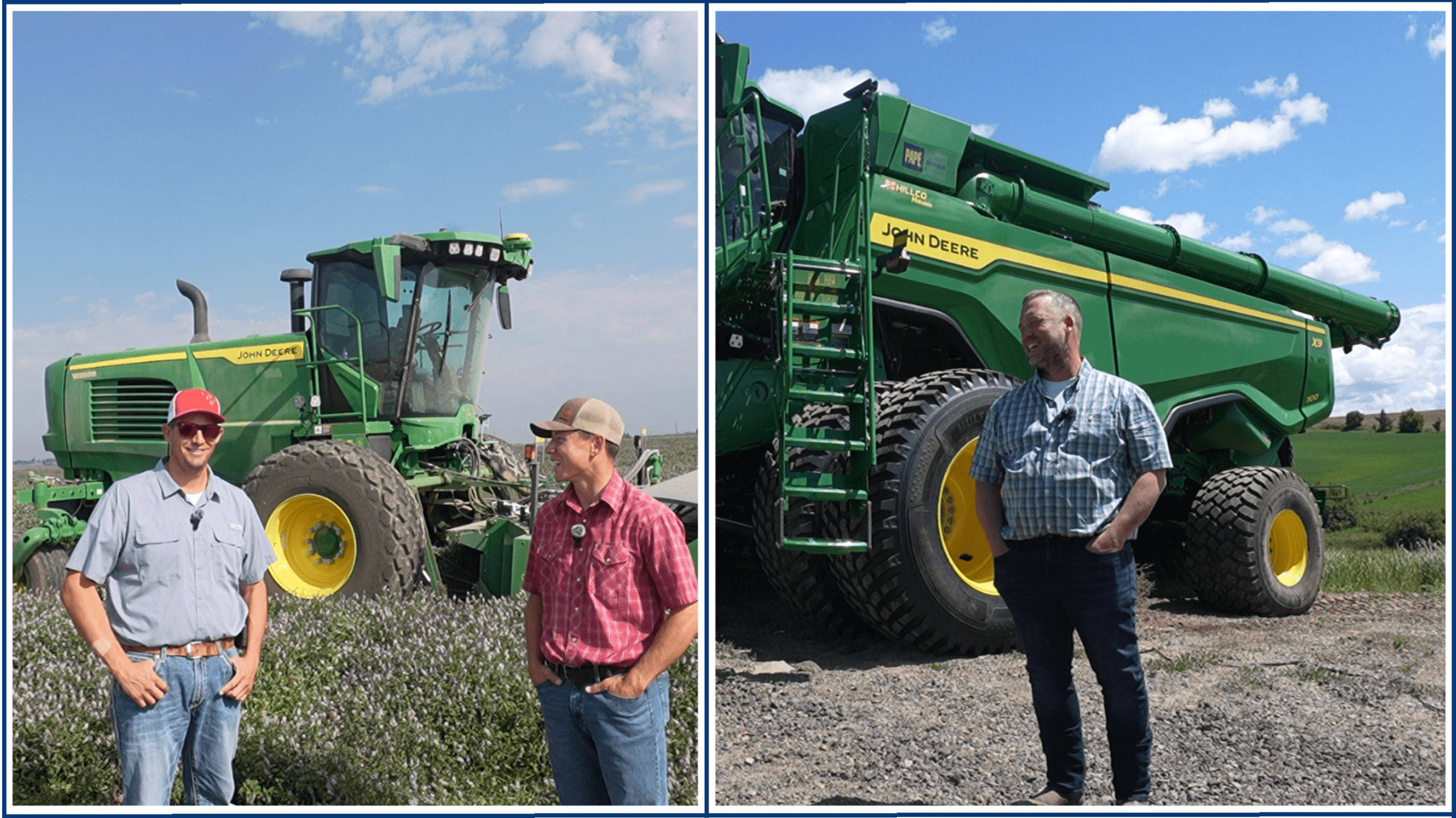
Hear directly from Hillco customers at Christensen and Millhorn Farms about the knowledgeable field support, equipment adjustments and personal service they experienced when it mattered most.
Enter your farm data to calculate what a Hillco leveling system puts back in your pocket. Fields are pre-filled with study data — update the numbers that apply to your operation.
🌿 Acreage & Crop Information
🌽 Corn
Total acres
Avg yield (bu/ac)
Price ($/bu)
🌱 Soybeans
Total acres
Avg yield (bu/ac)
Price ($/bu)
🌾 Wheat optional
Total acres
Avg yield (bu/ac)
Price ($/bu)
% of total acres per slope range — all crops combined (must total 100%)
0–3% slope
4–9% slope
10–15% slope
16%+ slope
⚠ Slope percentages must add up to 100%
⚙ Harvest Speeds (MPH) — Without Leveling System
With a Hillco leveling system, your combine harvests slopes at your flat-ground (0–3%) speed.
Slope
Corn
Soybeans
Wheat
0–3%
4–9%
10–15%
16%+
🌿 Reduction in Machine Harvested Yield (bu/acre)
Enter your estimated reduction in harvested yield (bu/acre) for each slope range when operating at your flat-ground speed (0–3% slope). The calculator will adjust these values based on the ground speeds entered for each slope range. Hillco study data is pre-filled and may be overridden with your own estimates.
Slope
Corn
Soybeans
Wheat
0–3%
4–9%
10–15%
16%+
🚜 Combine & Header Information
Corn head width (ft)
Flex header — soybeans (ft)
Wheat platform width (ft)
Field efficiency (%)
Typically 70% (separator hrs ÷ engine hrs)
Cost per separator hour ($)
$300–$400 new, ~$150 older. Enter $0 to exclude.
💵 Operational Costs
Operator labor ($/hr)
Fuel price ($/gal)
Fuel consumption (GPH)
Typically 16–20 GPH
📈 Leveling System Investment
John Deere S7 Sidehill (18%): ~$84,000 | John Deere S7 Hillside (28%) w/ dual tire: ~$155,400 | Case IH Flagship Sidehill: ~$82,000 | Case IH Flagship Hillside w/ dual tire: ~$152,500. Consult your dealer for used values.
List price of leveling system ($)
Market value after year 5 ($)
Hillco systems retain ~40% of original value after 5 years
Annual interest rate (%)
Calculation period (1–5 yrs)
Annual inflation rate (%)
Your Hillco Leveling System ROI
$0
total net cash flow over your selected period
0.0 yrs
Estimated payback period
$0
Grain savings (total period)
$0
Labor + fuel savings
$0
Combine resale value gain
Annual separator hours
0
Without leveler
0
With leveler
0
Hours saved/yr
0%
% savings
Payback progress (5-year window)
Payback: calculating...
Cash Flow Breakdown — 5 Years
Grain savings (reduced MHY losses)$0
Labor savings$0
Fuel & lubrication savings$0
Residual value of leveling system$0
Increased combine resale value$0
Total positive cash flows$0
Leveling system cost (principal + interest)$0
Remaining note balance (if period < 5 yrs)$0
Maintenance cost (2%/yr after year 1)$0
Total negative cash flows$0
Net cash flow$0
$0
Net present value (NPV)
0%
Internal rate of return (IRR)
Results are estimates based on your inputs and Hillco study data. Actual results may vary. Contact your local Hillco dealer for a personalized quote | 1-800-937-2461 | hillcotechnologies.com
Proudly American Made
2026 Hillco Technologies, Inc. All Rights Reserved.