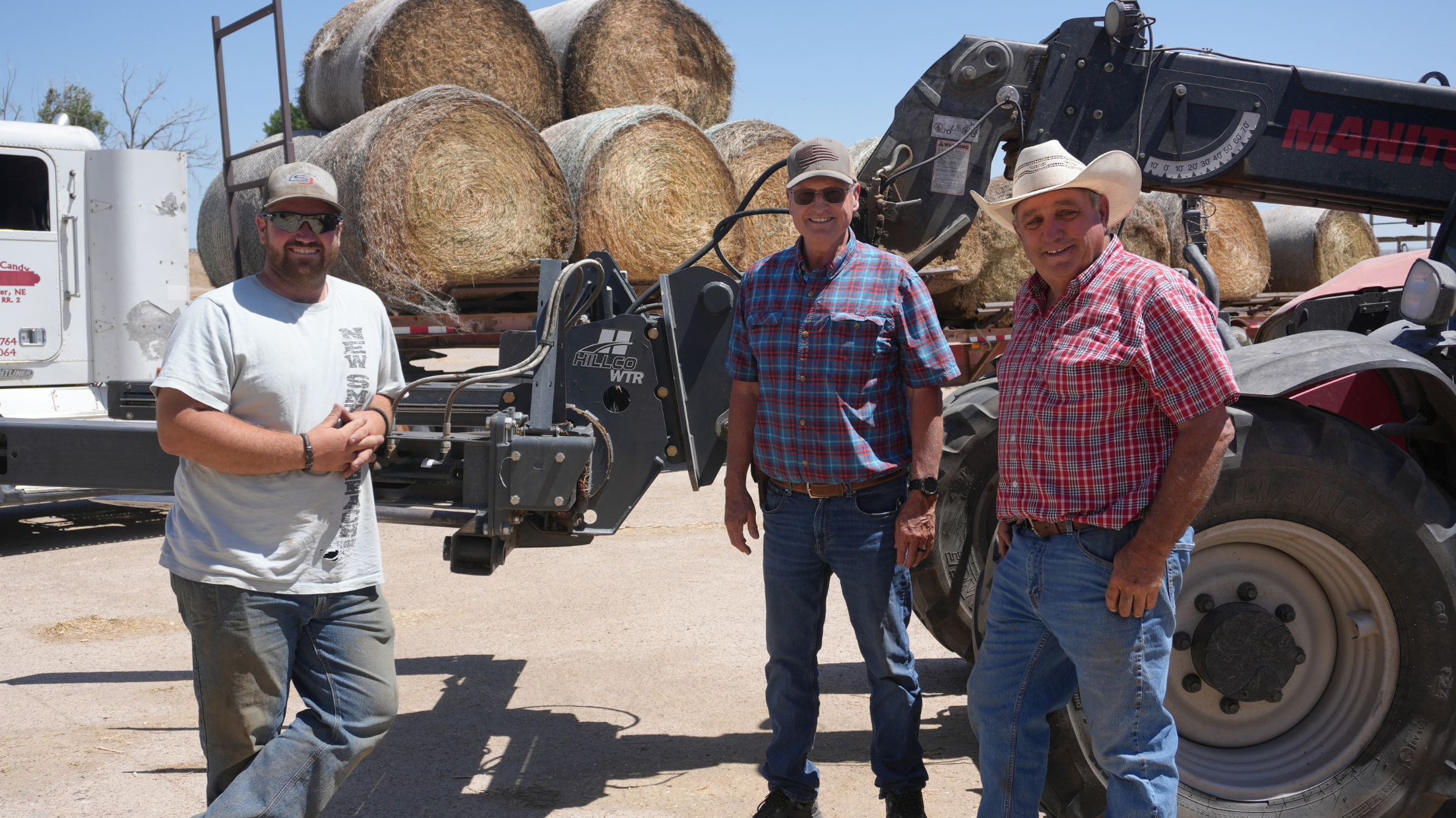
Quick Answer: Cutting the net wrap or twine off one bale isn’t something a person thinks much about, but a few hundred bales—that’ll get your attention. At Oshkosh Heifer Development in western Nebraska, experienced hay-grinding professionals Marty Zehr and Tyler Schroeder have put the Hillco Wrap Twine Remover through an extreme-use workload, cutting and collecting net wrap and twine while handling the bale—without crawling in and out of the cab upwards of 400 times a day.
Their unusually high bale volume did more than demonstrate the efficiency of the WTR. It gave Hillco valuable real-world feedback about where earlier units could be strengthened and how the product could continue to improve.
Cutting net wrap or twine from a bale is one of those jobs you don’t think much about—until you have a few hundred bales lined up and waiting. Then you start paying attention to what it is costing you in time, labor, and daylight.
Marty Zehr and Tyler Schroeder know that routine better than most. Marty is an independent contractor hired by Oshkosh Heifer Development (OHD), but his experience with grinders has deeper roots. He was formerly an owner of Diamond Z, the Idaho company known for manufacturing industrial tub and horizontal grinders, before the business was sold. Tyler operates his own tub-grinding business.
These guys have put in the time and know the world of tub grinding inside and out.
They may run separate—and sometimes competing—businesses, but they see eye to eye on the Hillco Wrap Twine Remover (WTR).
Both men have stripped their share of bales the old-fashioned way. After using the WTR at OHD, they see the value in addressing the efficiency of that extra chore. They have also used the attachment hard enough and often enough to help Hillco identify durability points that would be difficult to uncover under normal use cases.
“It’s like a built-in hired man. You just get in the handler and you’re a one-man band.”
— Tyler Schroeder, hay-grinding operator
The Bales Got Bigger
Marty has watched hay bale sizes grow throughout his career.
“My whole life, a bale has always been just a little bit bigger than me,” he said.
The small 50-pound bales he remembers handling as a kid gave way to two-string and three-string bales, followed by 3-by-3 and 3-by-4 large squares weighing around 1,500 pounds.
Larger equipment took care of the heavy lifting, but the strings still had to go.
With the large square bales at OHD, that meant pulling them from the stack, tipping them over, cutting several strings, peeling everything away, and then gathering the bales again. Round bales had their own routine: stand them up, space them out, cut the wrap, pull it free, and come back through with the loader—basically burning daylight.
Marty laughed as he described how the old process at OHD could spread a haystack across half the countryside, only for the operator to come back and gather it all again before grinding.
When there are hundreds of bales to grind, cattle waiting, and a long list of other chores to get done, nobody wants to handle the same bale twice.
Pick It, Strip It, Move On
The Hillco WTR is designed to cut, collect, and deposit net wrap or twine wherever the operator chooses from both round and large square bales.
The knife edge cuts the binding material, the hooks hold onto it, and the arms rotate upward to pull it away. The operator then releases the hooks’ hold on the net wrap or twine in a designated collection area.
The entire process can be completed without leaving the operator’s seat.
For Tyler, the benefit is pretty cut-and-dried: pick up the bale, strip the material, keep moving, and save time.
At OHD, the WTR is used to prepare bales in a loose pile so the grinder stays supplied. Instead of stopping the flow at every bale and reaching for a pocketknife, one operator can remove the material while staying seated and head for the next bale in a fraction of the time.
In Tyler’s words, it is a “built-in hired man.”
Good help can be hard to find, and an extra hand on a ranch is rarely standing around with nothing to do. There is always feed to push, water to check, bedding to spread, equipment to service, or cattle that need attention.
If one operator can handle bale prep from the telehandler, another person is free to take care of the next job on a never-ending list.
Thousands of Bales Tell the Story
Tyler estimated that he had run between 10,000 and 15,000 bales through the WTR over roughly the previous year.
That is not a light or occasional workload. OHD is an extreme-use case for the WTR, putting a large number of bales through the attachment in a relatively short amount of time. The pace gave Hillco an opportunity to see how the WTR performed under repeated, demanding use and to gather feedback directly from the people running it.
On the day of the interview, Marty and Tyler reported grinding 208 alfalfa bales in approximately two hours and 15 minutes. Before that, Tyler had already stripped around 150 straw bales that morning.
That is a full day’s work during coffee hour!
When you are dealing with that kind of volume, saving seconds or minutes on every bale adds up fast. A smoother preparation process can be the difference between knocking out the job and dragging it into another day.
“It turns a whole-week job into a couple of days.”
— Marty Zehr, former Diamond Z owner and independent contractor hired by OHD
When Extreme Use Becomes Product Development
Marty and Tyler did not tiptoe around their experience with the WTR. Tyler said that their high-volume use found a few weak points in earlier units, and Marty joked that Tyler had broken more than one of them.
For full context: OHD was putting the WTR through a volume and pace that goes well beyond its intended bale handling. In Tyler’s words, they were running enough quantity to find the weak spots.
“I’ve probably run 10,000 to 15,000 bales through it in the last year or so. It found some weak points in it, and they adjusted that and got it fixed.”
— Tyler Schroeder
The areas they identified included a cylinder pivot that needed more reinforcement and a knife that needed to reach deeper. Hillco took that information back, adjusted, and used their experience to help improve the WTR.
That kind of feedback is valuable. There is only so much a manufacturer can learn from testing a machine under controlled conditions. Put it into a demanding operation, run thousands of bales through it, and the workload will show you where the next improvement needs to be.
Marty, who has experience developing and manufacturing grinding equipment, understood that process well.
“You’re always innovating. The longer you’re building them, the better they get.”
His assessment of the WTR they were currently using was equally important: it was already doing the job they needed it to do.
Marty and Tyler ended the interview with a little good-natured humor about being willing to test the next version—and probably find a way to break that one, too.
As they put it, until something breaks, you don’t always know what is going to break. At OHD, their extreme workload gave Hillco the opportunity to find out, make changes, and build those lessons into the product.
Beating the Weather
Anyone who makes a living outdoors knows that a good weather window is worth using.
Later that afternoon, winds at OHD reached approximately 25 to 30 miles per hour. Tyler’s point was straightforward: if the crew had still been stripping every bale by hand, the wind would have cut them off much earlier.
While the Hillco Wrap Twine Remover cannot change the forecast, it can speed up bale preparation and help an operation finish grinding within a workable window.
For custom grinders, feedyards, and cow/calf operations, that may mean keeping the grinder supplied, finishing while conditions are still workable, and moving people and equipment on to the next job.
Handy for More Than Grinding
The same chore shows up in plenty of places besides the grinding pile.
Marty and Tyler discussed using the WTR when feeding round bales, placing hay in feeders, or opening straw bales for bedding. No matter where the bale is headed, the goal is the same: get the twine or wrap off, relocate it to a designated area, and process or feed the bale.
The WTR includes several adjustment options for different bale sizes and applications, including multiple spear locations, two arm-mounting positions, and adjustable hooks.
Bales vary in size, density, and condition, and no two equipment setups are exactly alike. We recommend talking with your local John Deere dealer or contacting Hillco directly to determine the right setup for your operation.
Would the WTR Pull Its Weight in Your Operation?
Take an honest look at your current bale-handling routine.
How many bales are you preparing? How long does it take to strip each one? How many times do you have someone climbing in and out of the cab? What else could that person be doing?
A few minutes may not seem like much on one bale. Multiply that by a hundred—or a few hundred—and you are talking about a good chunk of the day.
Most operations may never put a WTR through the kind of concentrated volume seen at OHD. That is part of what made Marty and Tyler’s experience so useful to Hillco: they pushed the attachment hard, found areas that could be strengthened, and provided the real-world information needed to keep improving it.
If net wrap and twine removal is creating a bottleneck for feeding, grinding, or bedding, the WTR can save time, improve the flow of the job, and reduce the need for operators to repeatedly climb out of the cab and handle knives, twine, and net wrap by hand.
The Hillco Wrap Twine Remover is available exclusively through John Deere dealers. Watch it work in feeding and tub-grinding applications, review the current product information, and speak with your dealer about compatibility with your bales and equipment.
While Marty and Tyler run independent businesses, they agree on the bottom line: the WTR is fast, practical, and built to handle a chore cattle producers deal with every day.
Their experience at OHD also gave Hillco something equally valuable: honest feedback from two experienced operators using the attachment at the far end of the workload spectrum.
Or, as Tyler put it, it is like having a hired man built right into the machine.
What does a wrap twine remover do during hay grinding?
The Hillco WTR cuts and collects net wrap or twine before the bale enters the grinding process. The operator engages the knife and hooks, releases the squeeze arms, and rotates the arms upward to pull the material away. The removed material can then be deposited in a designated collection area. Always follow the current operator’s manual.
Can the Hillco WTR handle round and large square bales?
Yes. The WTR is compatible with common 4-by-5, 4-by-6, 5-by-5, and 5-by-6 round bales, as well as large square bales up to 8 feet long. Bale dimensions and compression can affect performance, so confirm the correct WTR model, arm position, and setup for your bales.
Did Marty and Tyler experience any durability issues with the WTR?
Their extreme-use workload identified some weak points in earlier units, including an area around the cylinder pivot that needed reinforcement and a knife that needed additional reach. Hillco used that feedback to make adjustments and continue improving the WTR. Marty and Tyler estimated that they had put between 10,000 and 15,000 bales through the attachment in roughly a year. Their experience should be understood as an unusually demanding real-world test—not as a typical workload for every operation.
Is the production rate reported at OHD typical for every operation?
Not necessarily. The bale counts and production times in this article are observations shared by Marty Zehr and Tyler Schroeder from their work at OHD. Their operation is an extreme-use case that provided Hillco with valuable information about the WTR’s performance and durability under high-volume conditions. Results will vary depending on bale type, material condition, carrier setup, operator experience, weather, and the rest of the grinding workflow.
Where is the Hillco WTR available?
The Hillco Wrap Twine Remover is available exclusively through John Deere dealers.
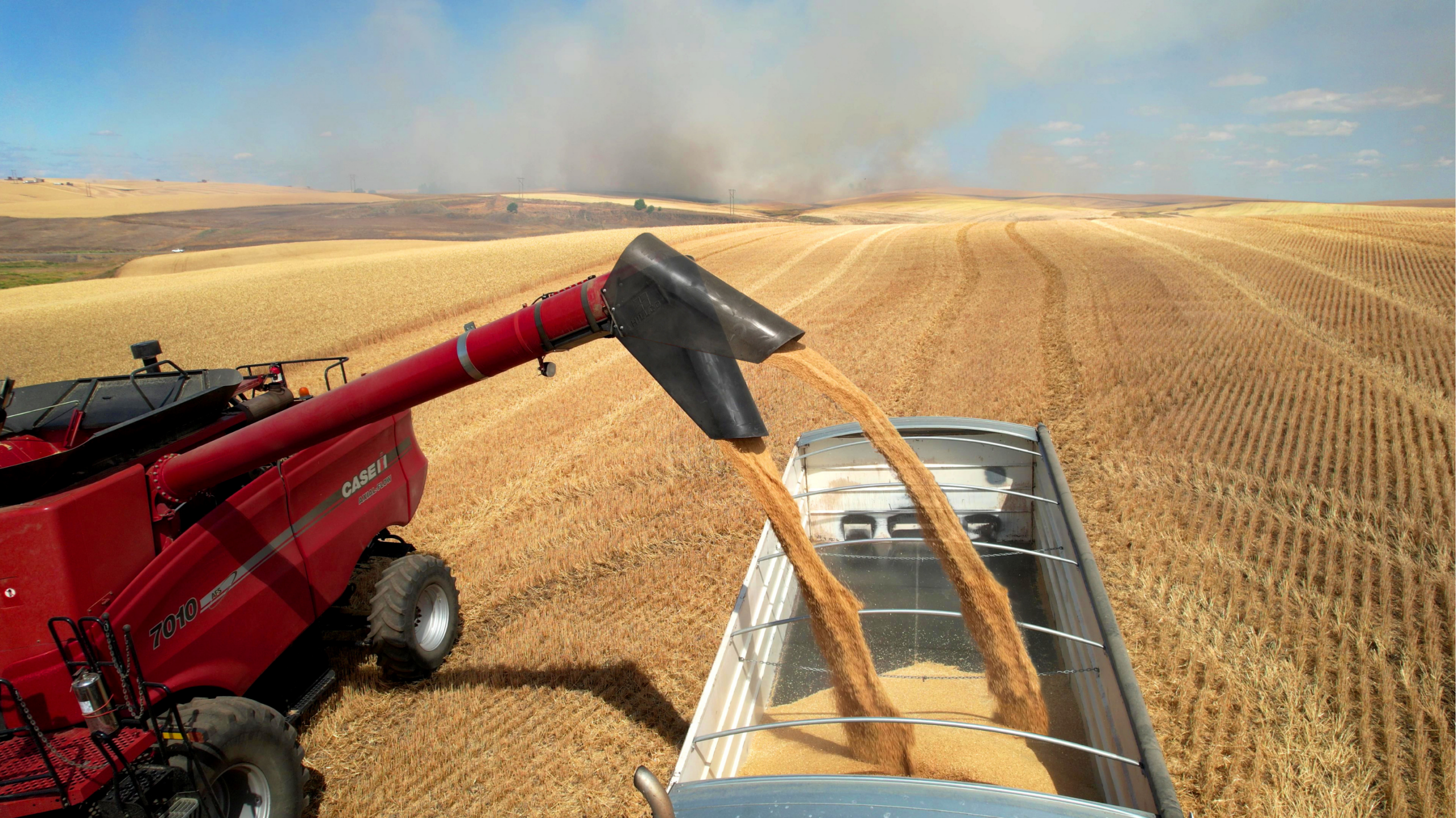
If you want better control over where grain lands in the cart, the Hillco Pivoting Spout is a practical upgrade for your Case IH combine. From the cab, a foot switch moves the spout through 37 degrees of travel, allowing you to direct the grain stream closer to or farther away from the combine without repositioning the machine.
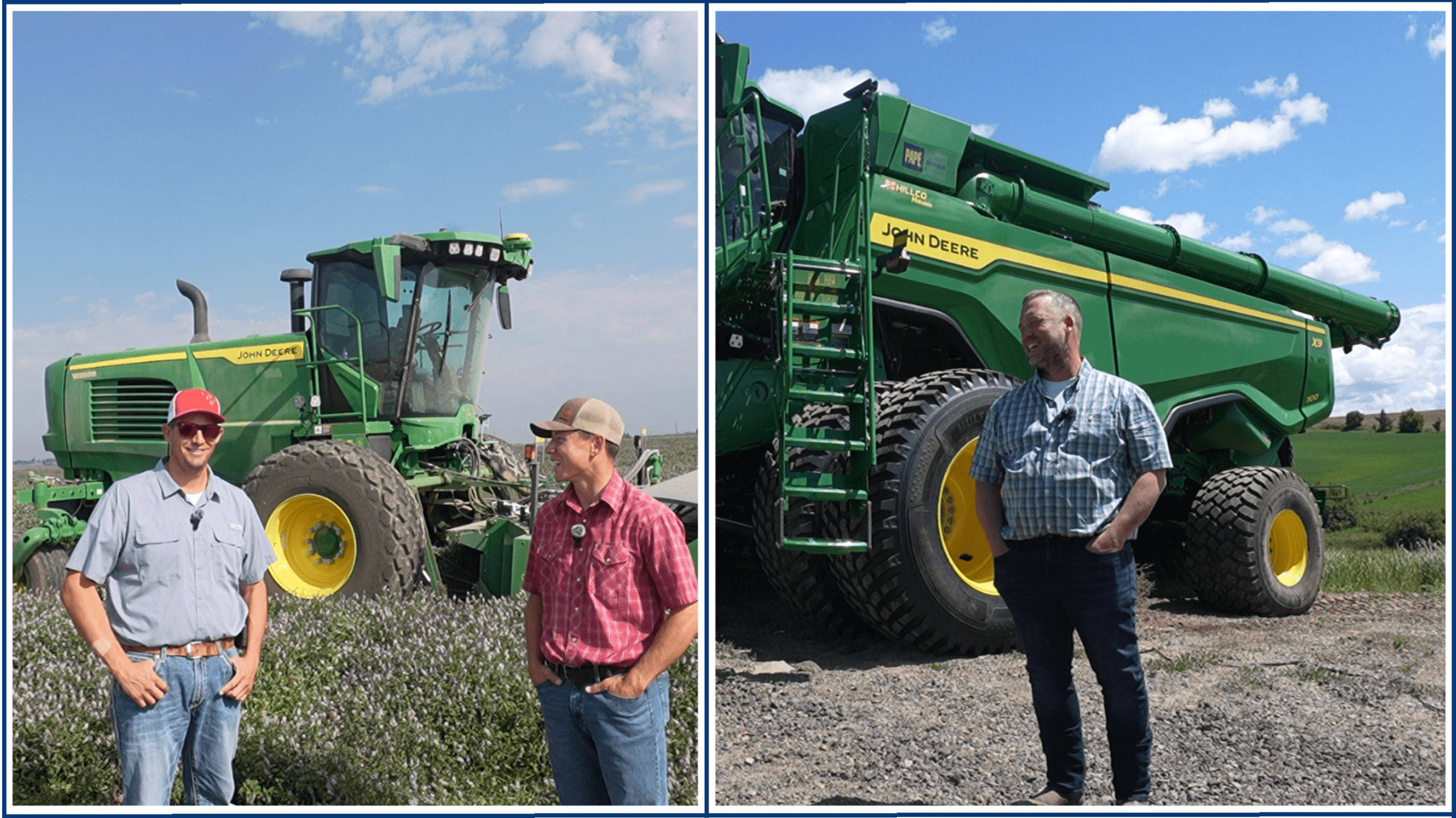
Hear directly from Hillco customers at Christensen and Millhorn Farms about the knowledgeable field support, equipment adjustments and personal service they experienced when it mattered most.
Enter your farm data to calculate what a Hillco leveling system puts back in your pocket. Fields are pre-filled with study data — update the numbers that apply to your operation.
🌿 Acreage & Crop Information
🌽 Corn
Total acres
Avg yield (bu/ac)
Price ($/bu)
🌱 Soybeans
Total acres
Avg yield (bu/ac)
Price ($/bu)
🌾 Wheat optional
Total acres
Avg yield (bu/ac)
Price ($/bu)
% of total acres per slope range — all crops combined (must total 100%)
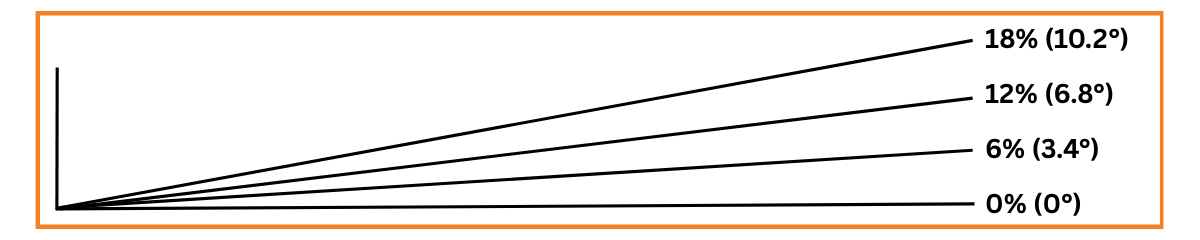
0–3% slope
4–9% slope
10–15% slope
16%+ slope
⚠ Slope percentages must add up to 100%
⚙ Harvest Speeds (MPH) — Without Leveling System
With a Hillco leveling system, your combine harvests slopes at your flat-ground (0–3%) speed.
Slope
Corn
Soybeans
Wheat
0–3%
4–9%
10–15%
16%+
🌿 Reduction in Machine Harvested Yield (bu/acre)
Enter your estimated reduction in harvested yield (bu/acre) for each slope range when operating at your flat-ground speed (0–3% slope). The calculator will adjust these values based on the ground speeds entered for each slope range. Hillco study data is pre-filled and may be overridden with your own estimates.
Slope
Corn
Soybeans
Wheat
0–3%
4–9%
10–15%
16%+
🚜 Combine & Header Information
Corn head width (ft)
Flex header — soybeans (ft)
Wheat platform width (ft)
Field efficiency (%)
Typically 70% (separator hrs ÷ engine hrs)
Cost per separator hour ($)
$300–$400 new, ~$150 older. Enter $0 to exclude.
💵 Operational Costs
Operator labor ($/hr)
Fuel price ($/gal)
Fuel consumption (GPH)
Typically 16–20 GPH
📈 Leveling System Investment
John Deere S7 Sidehill (18%): ~$84,000 | John Deere S7 Hillside (28%) w/ dual tire: ~$155,400 | Case IH Flagship Sidehill: ~$82,000 | Case IH Flagship Hillside w/ dual tire: ~$152,500. Consult your dealer for used values.
List price of leveling system ($)
Market value after year 5 ($)
Hillco systems retain ~40% of original value after 5 years
Annual interest rate (%)
Calculation period (1–5 yrs)
Annual inflation rate (%)
Your Hillco Leveling System ROI
$0
total net cash flow over your selected period
0.0 yrs
Estimated payback period
$0
Grain savings (total period)
$0
Labor + fuel savings
$0
Combine resale value gain
Annual separator hours
0
Without leveler
0
With leveler
0
Hours saved/yr
0%
% savings
Payback progress (5-year window)
Payback: calculating...
Cash Flow Breakdown — 5 Years
Grain savings (reduced MHY losses)$0
Labor savings$0
Fuel & lubrication savings$0
Residual value of leveling system$0
Increased combine resale value$0
Total positive cash flows$0
Leveling system cost (principal + interest)$0
Remaining note balance (if period < 5 yrs)$0
Maintenance cost (2%/yr after year 1)$0
Total negative cash flows$0
Net cash flow$0
$0
Net present value (NPV)
0%
Internal rate of return (IRR)
Results are estimates based on your inputs and Hillco study data. Actual results may vary. Contact your local Hillco dealer for a personalized quote | 1-800-937-2461 | hillcotechnologies.com
Proudly American Made
2026 Hillco Technologies, Inc. All Rights Reserved.